By RONALD BLUM AP Baseball Writer
NEW YORK (AP) — Major League Baseball proposed delaying the start of a salary cap until 2028, saying teams have too many commitments for next season that wouldn’t allow them to reduce spending quickly enough.
A day after the start of free agent negotiations for the 2026-27 offseason, owners on Tuesday proposed to players the sport adopt a hard cap of $258.2 million for 2028 and a floor of $180.2 million, using luxury tax payrolls with average annual values. A team would be allowed to remain as low as 90% of the floor in 2028, which would be $162.18 million, but would have to spend the entire amount of the floor over a three-year period.
“We recognize that clubs will need a full offseason to prepare to operate within the cap and floor system,” MLB spokesman Glen Caplin said in a statement. “This proposal would allow a smoother transition into the cap and floor system without delaying key player benefits, including earlier free agency, a $1 million minimum salary, a 30% increase to the pre-arbitration bonus pool and transactional reform that will reduce roster churn.”
Baseball’s five-year labor contract, reached in March 2022 on the 99th day of a lockout, expires Dec. 1 and management is expected to again lock out the union. MLB hadn’t proposed a salary cap since the negotiations that led to a 7 1/2-month strike in 1994 that forced cancellation of the World Series for the first time in 90 years. The players’ association has said it never will accept a cap.
“Coming off another incredible season of baseball, MLB owners continue to propose blowing up the current system and replacing it with one designed to line their pockets and increase their franchise values,” the union said in a statement. “Players stand ready to negotiate in good faith toward a new CBA that will capitalize on our sport’s unprecedented momentum and benefit players, clubs, and fans alike.”
Management’s proposal is tied to a 50-50 split of revenue with players, and the union takes issue with management’s definitions of revenue and expenses. Cap and floor figures would be lower if there is a work stoppage that causes MLB revenue to decline. Management’s May proposal included a fixed $245.3 million figure for a cap and $171.2 million for a floor, also with the provision a club could be at only 90% of the floor.
“The projected salary cap and floor for 2028 continues to provide more money for major league players while leveling the playing field and giving more teams the ability to participate in the free agent market and retain their homegrown stars so that every fan believes their team has a fair chance to win it all,” Caplin said.
Management said eight teams would have to reduce current payroll by a combined $528 million to get under the 2028 cap: Boston, the Chicago Cubs, the Los Angeles Dodgers, New York Mets and Yankees, Philadelphia, San Diego and Toronto.
Twelve teams would have to increase spending by $636 million to reach the floor: the Athletics, the Chicago White Sox, Cincinnati, Cleveland, Colorado, Miami, World Series champion Milwaukee, Minnesota, Pittsburgh, St. Louis, AL champion Tampa Bay and Washington.
MLB said it was willing to discuss phase-in timelines and procedures. It would keep the current luxury tax system and revenue-sharing plan for 2027 with the same thresholds and tax rates as in 2026, then centralize MLB media revenue for 2028.
Players claim the cap proposal would eliminate guaranteed contracts because of its escrow provision that would claw back salary money if the players’ share of defined revenue in a year is above 50%. The union called the plan “replacement of market-based fundamentals with a zero-sum system that harms the middle class and pits player against player” and said the proposal would lead to “stripping current competitive advantages for smaller market teams.” Players said the proposal would cause a $400 million reduction in amateur signing bonuses for 2027.
Owners said they would accept the union’s proposal to reduce service time for free-agent eligibility from six seasons of service to five for players at least 30 years old but would give a player’s team the right to make a qualifying offer as under the current free-agent rules. If a player rejects the qualifying offer, he would be eligible for salary arbitration.
MLB would accept the union’s proposal to eliminate qualifying offers for other free agents.
Management would raise the minimum salary from $780,000 to $1 million for those with two years of service and $900,000 for others — those others would earn $100,000 more from the pre-arbitration bonus pool if they accrue a full year of service as long as they are not on the injured list for half a season or more. Minor league minimums would increase from $63,600 to $73,400 for initial big league deals and $127,100 to $146,700 for additional contracts.
MLB proposed a one-time bonus payment to players as part of the plan, using money from luxury tax proceeds the current labor agreement earmarks for players’ 401(k) accounts. The bonus would be based on 2026 service time, with those in the majors for at least 172 of the 187-day regular season getting $285,000. The bonus would be $213,400 for three-quarters of a year, $142,300 for half and $71,100 for a quarter.
MLB would increase the pre-arbitration bonus pool from $50 million in 2026 to $65 million in 2027, then up to $75 million over the term of a seven-year labor agreement through the 2033 season. It would include Prospect Promotion Incentive draft picks in the international draft MLB wants and would allow a player to earn his team two PPI picks, one in the amateur draft and the other in the international draft. MLB would accept the union’s proposal to exclude foreign professionals, such as Japanese players, from the calculation if a player earns additional service time based on his finish in Rookie of the Year voting.
Owners would eliminate a player’s fourth option year and reduce optional assignments per season from five to four. They would decrease the number of years by one for when a player must be protected from the Rule 5 draft and allow a player selected in the Rule 5 draft to be optioned.
___
See AP’s full MLB coverage here
News
Major League Baseball proposes delaying salary cap start until 2028 in talks with players
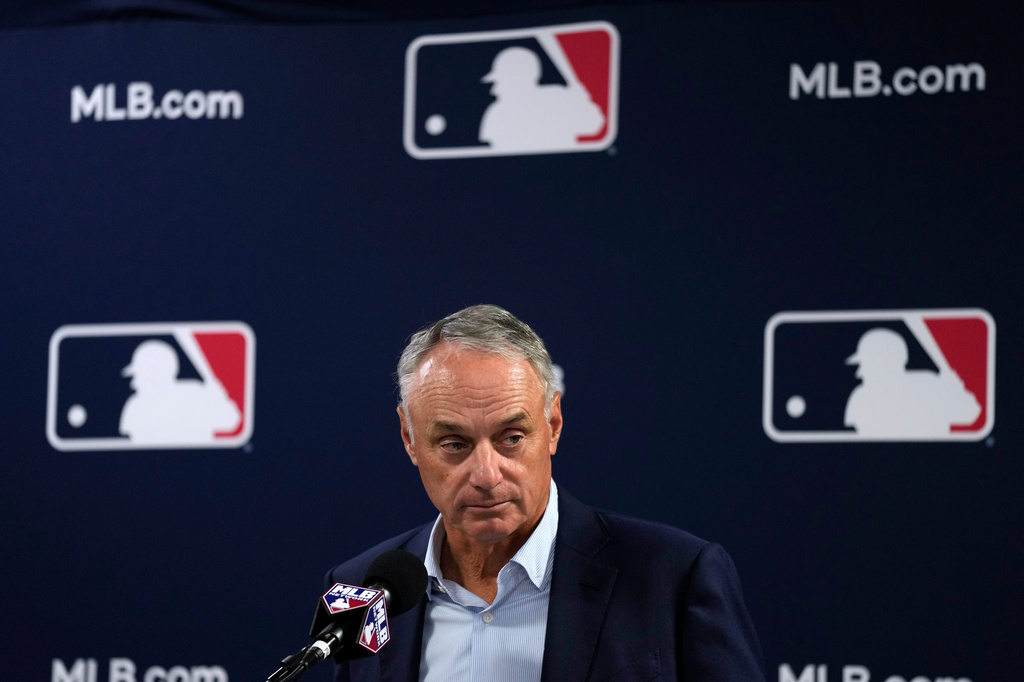
FILE - Major League Baseball commissioner Rob Manfred speaks during a baseball spring training media day, Feb. 15, 2024, in Tampa, Fla. (AP Photo/Charlie Neibergall, File) Photo: Associated Press