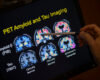
CHARLOTTESVILLE, VA (CVILLE RIGHT NOW) – Two new UVA Health specialists are looking at ways focused ultrasound, used effectively in treating essential tremor and Parkinson’s symptoms, can be used as non-invasive treatment for addiction, substance abuse disorder, and other mental health issues. Drs. James Mahoney and Daisy Thompson-Lake are researchers in the UVA Center for Leading-Edge Addiction Research, and both came to UVA from West Virginia University to work with focused ultrasound research into this new pathway. Dr. Mahoney told CvilleRightNow they’re looking at use of the new technology as one of the tools that can help treat someone with substance abuse disorder along with other mental health issues. Focused ultrasound could be used in concert with medicine and/or behavioral techniques to better serve the patient.
“It’s a really complex disorder, said Dr. Thompson-Lake.
“And that’s why it is such a challenge for us to try and treat it, because not all substances work the same way in the brain. So, methamphetamine, for example, you’ve got these huge brain-wide doses of dopamine going on, whereas with opioids, it’s a very specific, you know, targeting the pain and the reward circuitry. So, because of that, we can’t find a medication that’s going to work for all these different substances.”
Additionally, she said many people are using many different substances.
“So going back about 5 years or so, where Daisy and I were located at West Virginia University and the Rockefeller Neuroscience Institute, we came up with, you know, an idea to start looking at focused ultrasound for addiction based on other neuromodulation studies,” Dr. Mahoney said.
“So, for example, transcranial magnetic stimulation is a form of neuromodulation. It’s currently approved for depression. It focuses on those outer areas of the brain.”
“And also, deep brain stimulation. We had a protocol that was funded by the National Institute of Drug Abuse, looking at deep brain stimulation for addiction,” Dr. Mahoney explained.
“Now, deep brain stimulation, it’s able to get those deeper areas of the brain, which, again, we’ll talk about shortly. The drawback to it, though, is that it’s an invasive, it requires an invasive surgery, planting electrodes, and then the implantable hardware. So when you look at things like… like scalability and feasibility, it just doesn’t quite have that.”
“What we wanted to find was a treatment that can target those deep areas, like deep brain stimulation, but also be non-invasive like transcranial magnetic stimulation is. So focused ultrasound really addresses both of those issues.”The two are now developing research infrastructure at UVA for focused ultrasound treatment studies. They are preparing proposals and plans for clinical trials with potential recruitment in early 2026. Their intent is to explore ultrasound applications for both adult and adolescent populations.